Nehemiah Chapter 3 & 4 – Discouraged, Not Defeated

Nehemiah - Called to Lead

Consider the life of Al. Born in the Kentucky hinterlands, he had a modest upbringing of illiterate parents, lost his mother to fever at age nine. Al lost his first business venture. So he ran for state office, he lost. OK, so Al starts another business which failed.

Two years later his wife dies, Al is devastated. In fact, of his 4 sons, only one lives to manhood. Indefatigable, Al gets up, brushes himself and makes another stab at public office. He loses again.  Al develops a b lack depression which he sometimes referred to as “the hypo” or hypochondria, which would haunt him throughout his life, especially after the death of his first wife, Ann.

A third political defeat, a fourth, a fifth political defeat. But then..

Oh did I say Al? I meant to say AL, as in Abraham Lincoln, sixteenth President of the United States, presiding, conducting, and winning the Civil War, Emancipator of slaves, and heals of a nation, “with malice toward none” toward his captives.

In his early life, Lincoln had few books for education, chief among these were Pilgrim’s Progress by Paul Bunyan, and, of course, the Bible. Said Lincoln:

“I believe the Bible is the best gift God has ever given to man. All the good from The Savior of the world is communicated to us through this Book.”
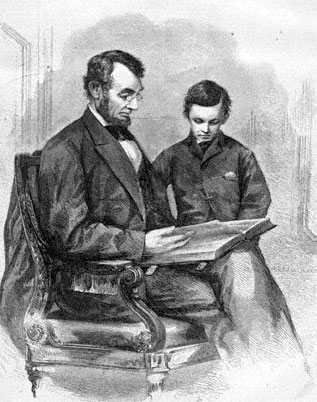
Abraham Lincoln reading with son Tad

A piece by the Lincoln Institute quotes Joshua F. Speed in an encounter:
 “As I entered the room, near night, he was sitting near a window intently reading his Bible. Approaching him I said: “I am glad to see you so profitably engaged.’ ‘Yes,’ said he, “I am profitably engaged.’ ‘Well,’ said I, ‘if you have recovered from your skepticism, I am sorry to say that I have not.’ Looking me earnestly in the face and placing his hand on my shoulder, he said: ‘You are wrong, Speed. Take all of this book upon reason that you can and the balance on faith, and you will live and die a happier and better man.’”. 

Source: The Lincoln Institute

Can their there be little doubt that Abraham Lincoln had learned the lessons of another great leader, Nehemiah,  whose book Lincoln studied?

Summary / Thoughts
The Wallbuilders

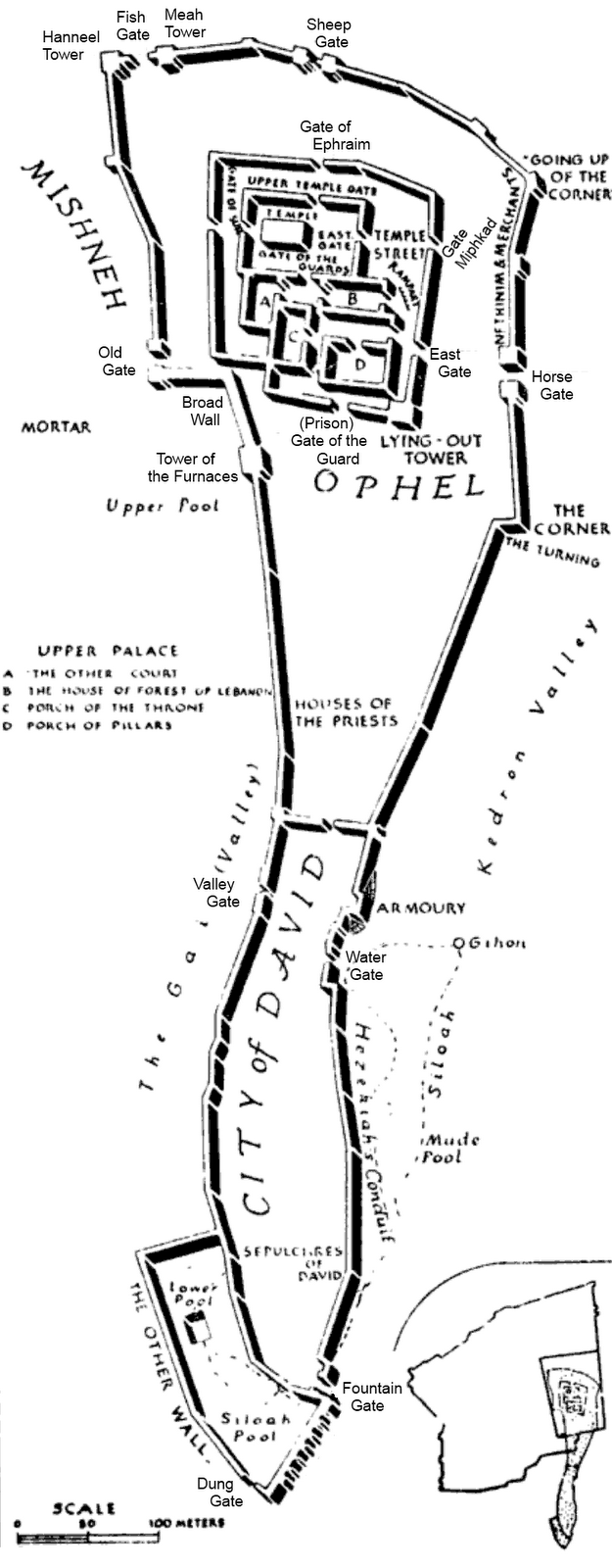
Nehemiah 3:1 Although Chapter 3 is mostly an enumeration of the workers, several points bear closer scrutiny. The High Priest and his family arose to build the Sheep Gate, at the north end of the Old City, close to the Temple.  This pattern of people rebuilding near their homes is repeated throughout the workforce.
Nehemiah 3:5, 27, 31-32 Although the people of Tekoa, a town about 8 miles southwest of Jerusalem engaged in the building, the town leaders did not, possibly due to Tobiah’s influence. It is possible to do the right thing even when the leaders do not. In fact the Tekoites, to their credit,  completed two different sections of the wall.
Nehemiah 3:8-9 The well heeled joined in the work, a testament to Nehemiah’s leadership, and probably their own self-interest.

Hope is an interesting thing. Sir Francis Bacon remarked that “Hope is a good breakfast, but it is a bad supper.”

Hope in the salvation and return of Christ is a great thing. The hope of Hebrews 6:19 is the anchor of the soul.

But hope demands action. Psalm 9:10 God moves in response to those who put their trust in God.

Nehemiah understood this, and did not wait passively when confronted. As always, his hope, trust, and faith were in God Almighty, but based on that faith, he took action. Some would say outside of hope in its Heb 6:19 context, the opposite of (human, passive) hope is action.

The enemies of the Jews are, in essence,  the same today as then:

Nehemiah’s Enemies were:

Sanballat

Tobiah the Ammonite

The Arabs


Discouragement & Defense

Nehemiah 4:1-3 Did you think that when you are engaged in God’s call for your life, it was going to proceed without hindrances? Jesus’ enemies and even the ignorant attempted to hamstring Him at every turn. Note that the audience here includes Sanballat’s power base, an doubling of the supposed power of his discouragement.
Nehemiah 4:4-5  Discouragement is perhaps the best weapon the Enemy has in his playbook. And to have 2 different people come at you from different sides, Nehemiah did the first best thing, he prayed.
Nehemiah 4:6-9 The people had a mind to work! Wow, would that we. What distracts you, how do you lose focus? Usually, you don’t really care, or are otherwise unmotivated. It isn’t important. Increase the importance, increase the will to work.
Nehemiah 4:10-14 Exo 14 ias an excellent parallel to this, Moses’ leadership fighting both Pharaoh and his own people, and the “mixed multitude” that departed with the Jews. Nehemiah took definite action and spoke bravely to the leaders and people
Nehemiah 4:15-23 God discourages our enemies. As hard as that is to keep that in mind during trials, it is, nonetheless true. See 2 Sam 17:14, Job 5:12The parallel for us is that we never proceed without our weapons, the full armor of God, to our life. As the Jews did in the work and life, so must we.I wonder how the civilians obtained weapons of war were probably brought in by the army, for the only other reliable manufacturer of weapons was the Philistines, (Ashdod was a Philistine city). They remained vigilant day and night. This too is a parallel for us. 1 Pet 5:8

Memory Verse – At whatever place you hear the sound of the trumpet, rally to us there. Our God will fight for us.. Nehemiah 4:20 

Application – Take courage, God will fight the battle. Simply show up with the full armor of God. 
Nehemiah Chapter 2 – Guided & Led to Lead

Nehemiah Chapter 2 - Guided & Led to Lead
Nehemiah Chapter 2 – Guided & Led to Lead

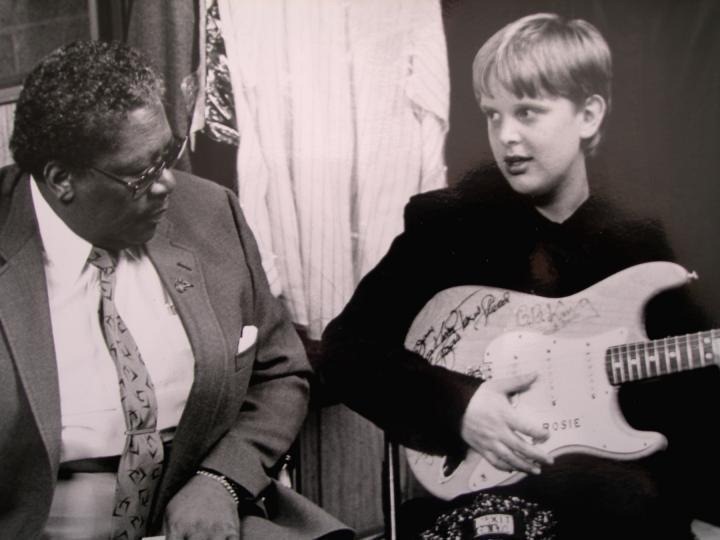
Anyone who loves the blues knows of guitar blues icon Joe Bonamassa. At age 11, he burst on the music scene playing backup to another blues legend, BB King, who seeing the spindly youth play his heart out on a Fender Strat, was so impressed he toured with BB in 1989. Quoted King:

“This kid’s potential is unbelievable. He hasn’t even begun to scratch the surface. He’s one of a kind.”

Joe Bonamassa with BB King

When asked his secret to success, Joe answered, “It was about 10% talent, and 90% hard work. You can’t succeed in this business without it. There’s no substitute for hard work.” Without a doubt Joe’s hard work has revived what was once considered a musical genre that had seen its apex.

But what the world didn’t see, was years and years of disciplined training, coaching, and encouraging by his father, a dealer of musical instruments. So immersed in blues was Joe, that success became the obvious result of preparation meeting opportunity. Certainly his work ethic is not in isolation.

Even a cursory reading of chapter one and two gives us insight into the previous life of the son of Hacaliah. What can we discern of the man? First off, we see deep patriotism. (Neh 1:2-4) Patriotism is not a natural sentiment, it is a deeply penetrating liniment applied to the soul;  dressed, and repeated from the locker of family values.

Also from this heritage is his natural, deep, and rich prayer life. (Neh 1:5-10). So much so even to the present day, Nehemiah’s prayers are held up both both Christians and Jews for their passion, structure, and effectiveness. Again, this was not learned in isolation, but from parents who treasured God and His Word. Even the pattern imitates the “Lord’s Prayer” of Matthew 6 in its simple, logical fashion, honoring the person of the Father, acceptance of His will in our lives, and so on.

More? That Nehemiah had risen to the high position of cupbearer to the king was surely no accident of circumstance.  The core purpose was to help ensure no poison touched the king’s lips by ambitious provocateurs. A deep level of trust was implicit between cupbearer and regent; most often that trust widened to one of trusted advisor. Only a man shown to be trustworthy under prolonged scrutiny could ever hope to be chosen for this important position.

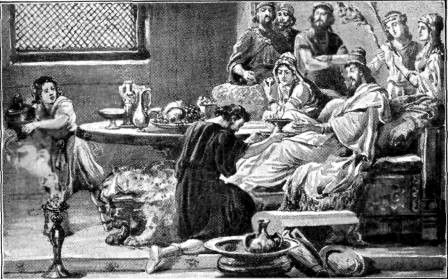
Nehemiah before Artexerxes

Then what shall we say of the hand of God in Nehemiah’s life? The Holy Spirit has sovereignly elected him the distinction of authoring a book of the Bible, not a privilege available to most, but God’s decision alone. And there were doubtless many who possessed Nehemiah’s Godly heritage, self discipline, and drive. But only one was chosen by the king, or should we say, chosen by the King:

The king’s heart is like channels of water in the hand of the Lord; He turns it wherever He wishes.” – Proverbs 21:1

We might not be tasting in the king’s service, but we are sons and heirs in the King’s court. Let’s sup with Him.

Summary / Thoughts
Nehemiah’s Prayer is Answered

Nehemiah 2:1-2 Four months have passed since Nehemiah’s prayer. Do our prayers seem unanswered? Why so sad? After all, four months have passed, life moves on, right? No. The angst he felt for his country and countrymen persisted. The cupbearer would approach the king with the cup, a long fringed and embroidered napkin for the king to wipe himself. The cupbearer poured the wine fem the cup in his right hand into his left palm, and drank it in the king’s presence. Pharaoh and Solomon also used cupbearers. Being a prominent courtier, the order of the courtiers was to be merriment at all times. Compare the encounter with Hadassah’s (Esther) Esther 4:4-5:4. Esther braces and tried to hide her concern over Haman with her beauty and adornment, but despite this, Artexerxes  (via God, of course) showed favor anyway.
Nehemiah 2:3-5 Having this angst bottled up for so long, is now confronted by the king to bring his problem to the forefront. Sometimes God protects us from our natural tendency to deny real emotion and passion when He desires the healthy best choice of confronting issues, as Christ did. Most importantly, he prayed for an answer. First was the drawn out formal prayer of chapter one, now a simple “God, what do I say?!Can you think of times when Christ could have avoided confrontation but instead met it straight on?
Nehemiah  2:6-8 Once emboldened by the positive response, he now asks boldly for what he needs. Do you think he prepared this list in advance? Do you ask boldly of God?
Nehemiah 2:9-10 Sanballat, a man of compromise. He was a Samaritan. Good information on him is here: http://www.antiquities.org.il/article_Item_eng.asp?sec_id=36&subj_id=286His life was a compromise. He was connected to the building of the Samaritan Temple at Mt. Gerazim, and had great political interest in seeing the Jerusalem Temple be not built. He is mentioned in an ancient text, the Elephantine papyrus. The Elephanitnes were a Jewish colony in Upper Egypt who wrote, among other things, for material support.   The crux of the controversy includes which Temple should the Jews worship at? Even as late as the time of Christ, the woman at the well of John 4:19-20 asks the question, or rather attempts to deflect Jesus’ point of her need for salvation. However at this time, the Temple God manifested Himself in was at Jerusalem, dedicated and paid for by David, and built and consecrated by Solomon (2 Chr 6 & 7)
The Old City of Jerusalem

Arrival in Jerusalem and Inspection of the Walls

Nehemiah 2:11-16 Guided by the Holy Spirit, he proceeds with his mission. There is a time for consensus, planning and vision casting (Pro 11:14, 12:15, 15:22 and elsewhere), and there times when it is best to act in discretion (Pro 12:23), so as not to allow enemies an advantage, and allies misunderstanding. Nehemiah is merely gathering intelligence that he will act on later.
Nehemiah 2:17-20  Nehemiah’s discretion pays dividends in the appeal to the people and the rebuke of his enemies. More on them next week!All in all, Nehemiah remains fully reliant on God.

Memory Verse – When I heard these words, I sat down and wept and mourned for days; and I was fasting and praying before the God of heaven. Nehemiah 1:4

Application – I will pray with passion and purpose and without compromise. 

Nehemiah – Called to Lead

Nehemiah - Called to Lead

What defines a leader? Are they made, or can anyone be a leader? What’s the difference between a leader and a manager, a coach, an officer, or political office holder?

Steven Covey called them by another name.. In his best selling self-help / business book, The Seven Habits of Highly Effective People, he includes “Be proactive,” “Begin with the end in mind,” Think Win/Win” and so on.

Sports offers a different kind of model, “overcome adversity,”  “Leaders aren’t born, they’re made” (Lombardi), Bobby Knight’s “either you’re in or you’re out,” and a personal favorite from Yogi Berra: “90% of this game is half mental.”

What does God say about leadership? He holds out many good examples, such as Abraham, Moses, Joshua, David, Daniel, and Nehemiah, whose book we will study.

A key point comes from the prophet Samuel:

When they entered, he looked at Eliab and thought, “Surely the Lord’s anointed is before Him.”
But the Lord said to Samuel, “Do not look at his appearance or at the height of his stature, because I have rejected him; for God sees not as man sees, for man looks at the outward appearance, but the Lord looks at the heart.”  –1 Sam 16:6-8

God calls those ready, not ready (God had to wait 40 years before Moses was ready), those unwilling; again Moses,  Gideon, and Jonah in Exodus 4, Judges 6:37-40 & Jonah 1.

God calls on those who communicate, with people as well s God. Again Moses was assisted by God communicating with people through his brother, and often spent spent up to 40 days in communion with the Almighty.

Nehemiah makes no less then 11 recorded prayers in the book, a testament to his reliance and close communion.

Nehemiah relies on, and acts on faith in God’s goodness and promises, having committed himself to God, he takes decisive action, often at personal risk, ridicule, and threat of personal harm.

Nehemiah had a deep passion for the problems he observed. This lead him to “constructive dissatisfaction.” He allowed the passion, under God’s control, to impel him to action guided to achieve God’s desire that His Temple be completed, and that the people of Israel take the 70 year lesson of captivity to heart and return to Him and thus be reformed.

Timeline:

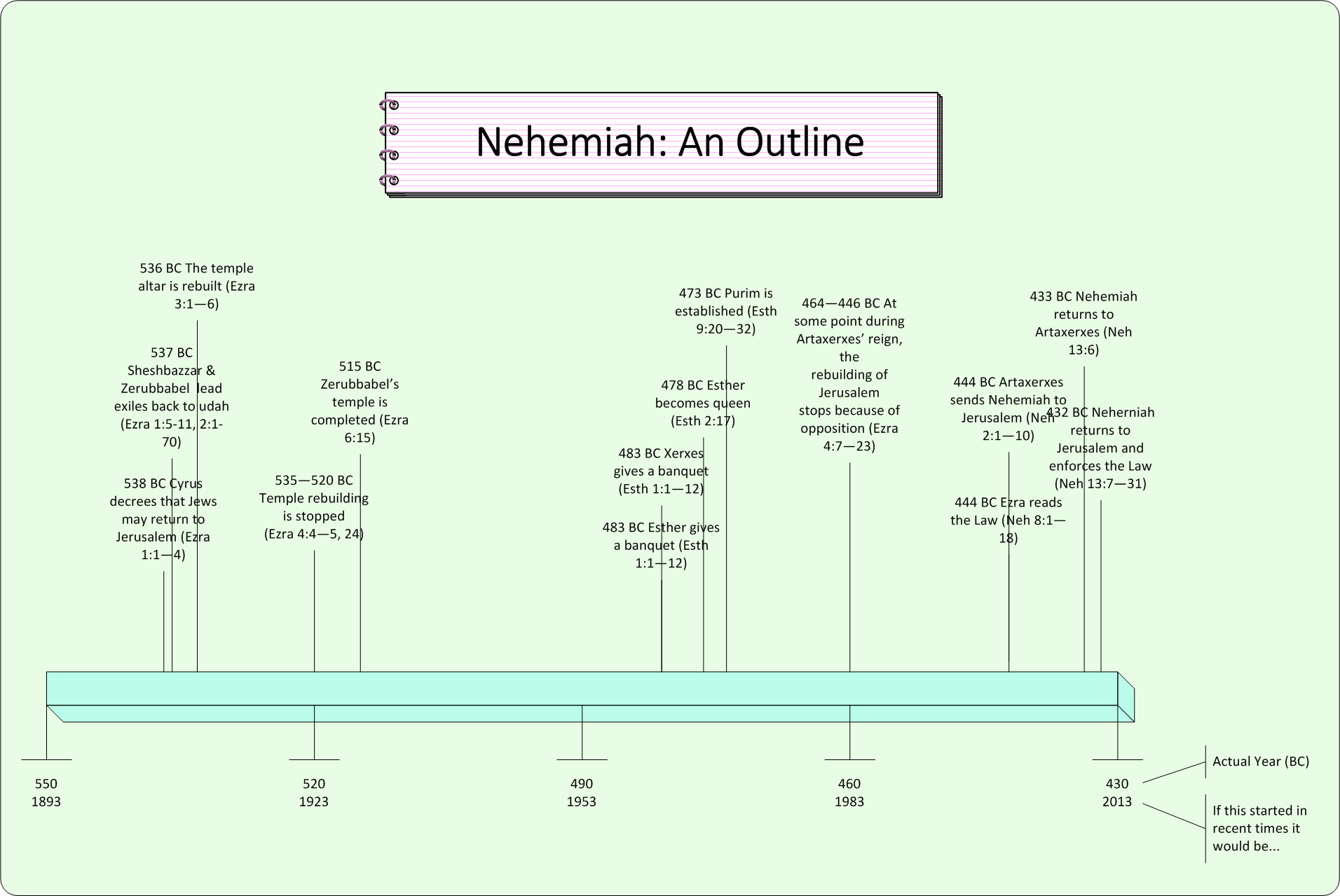
The life and times of Nehemiah

In 538 BC Cyrus decreed the Jews could return to Jerusalem and rebuild  a direct fulfillment of Daniel’s famous Seventy Weeks’ Prophecy recorded in Daniel 9:24-27

Zerubbabel began the return from exile nearly 100 years before Nehemiah began his journey there. A group of exiles had begun rebuilding the Temple, but and become discouraged after the locals plot to compromise the work was rejected by Zerubbabel and Jeshua, the governor and high priest, respectively.

After an interim period (during which the book of Hadassh, or as we know it, Esther, took place under Artexerxes.

After these things, the timeline of Nehemiah commences at 444 BC. Nehemiah remained as governor for 11 years after which he returned to his role as cupbearer for a brief time, and then returned to Jerusalem, overseeing it’s spiritual and national revival. He is recorded ceased his leadership role sometime before 400BC.

 
Book Outline:

Chapters 1 – 7  Rebuilding the Walls
Chapter 8 Returning to Truth
Chapters 11 – 12  Reforming a Nation
Chapter 13  Reviving a People

Summary / Thoughts

Neh 1:1-3 Chislev – Nov/Dec, 20th year. Of King Artexerxes. The style of writing appears to be from an excerpt of a personal record or diary. Josephus records that he overheard men speaking in Hebrew, and was thus attracted to the conversation, and his natural concern for people drove the conversation (Antiquities, Book 11 Chap 5 para 6)
Neh 1:4 He reacts as a Godly man will, deep passion, fasting and prayer. Note the structure of his prayer:
Neh 1:5 Acknowledging God’s attributes
Neh 1:6 Calls for attention – Luke 11:1 and persistence in prayer
Neh 1:7-8 A confession of his personal and national sin and its consequences
Neh 1:9-11  An appeal to His promise to Moses and to the Jews (and us!)

Memory Verse – When I heard these words, I sat down and wept and mourned for days; and I was fasting and praying before the God of heaven. Nehemiah 1:4

Application – I will pray with passion and purpose. 

Black Friday, Dark Nation

Q:”Dad, when is Thanksgiving?”
A:”The 4th Thursday in November.”
Q:”Oh, you mean the day before Black Friday?”

Pray for your nation. Like you never have before.

Hebrews Chapter 13

Practical Living Under Our Great High Priest
Having heeded the exhortation to faith an liberated from the curse of the Law, how then should we conduct ourselves? By manifesting (showing or demonstrating) love.
Simply Broken Out 

Heb 13:1-4 Showing Love to Others The operation of love is a verb, extending from fellow believers to the low parts of society, from which you cannot repay, as Jesus admonished the disciples in Luke 14:13-14. The focus is not on whether we look for angels, we won’t directly recognize them. Rather, be hospitable and loving toward the poor. The downtrodden are also objects of our love. Prisoners may or may not be guilty, but our Lord died for them as well. The ill-treated are to be comforted, 2 Cor 1:3-13This love is also to be manifested to spouses by respect and fidelity.Hospitality: Hospitality is caring for the traveler. In the Old Testament, examples abound where strangers  arrive in to an encampment, and Middle Eastern custom compelled the head of the camp to take in travelers. Abraham is a great illustration of this custom, as are other examples in Judges when Manoah entertained the Angel of the Lord, and the sad tale of Micah and his concubine in Judges 19:15 ff
Heb 13:5-14 Showing Love by Faith in our High Priest The love of money is another way of saying that we really can’t trust God to provide for us, that this we need to do for ourselves. That does not excuse laziness; we must earn our bread. See 1 Tim 5:8. Strike a balance. Our teachers and instructors are to be imitators of Christ, so that those instructed and copy their life. And that teaching is that the Gospel is the Good News, no longer tied to the Mosaic Law or any other aberration of the simple Gospel. Jesus hasn’t and won’t change, therefor the message never changes. (The medium always changes, though, see 1 Cor 9:20-23 and Paul’s example)
Heb 13:15-19 Showing Love by Self-Sacrifice As opposed to the old sacrificial system, the new sacrifice is a living sacrifice of our lives to Jesus shown by Paul in Romans 12:1We also sacrifice our wilfulness by sharing from a generous heart, submission to duly appointed authorities, and willing prayer for others with needs.
Heb 13:20-25 Showing love by receiving blessing What is it that God gives us to do His good will? All the things which we cannot do…. Fruits of the Spirit,

Memory Verse – Through Him then, let us continually offer up a sacrifice of praise to God, that is, the fruit of lips that give thanks to His name. Hebrews 13:15

Application – I will live my life showing love by demonstrating thankfulness. 

Hebrews Chapter 12

Living Our Life of Faith 
How, What, and Where  to live in the light of faith in our Great High Priest is the theme of Hebrews 12. Our examples are Jesus, and the saints of faith before us. Our heritage and is an unshakable one, Heaven. 
Summary / Thoughts

Heb 12:1-3 – Jesus Our Super Model Simply: Shed sin. Shake it off like a lizard sheds his skin, like Paul shook off the snakebite of Acts 28:2-5Compare this with the kenosis of Phillipians 2. The emptying, the deprivation Jesus went through to lay aside is Godhood, AND voluntarily put up with the hostility of which we receive only a bare fraction.
Heb 12:4-11 – The Father, our Teacher Someone once remarked that he was glad to have been in the army, but wouldn’t want to do it again. Discipline is the same way, it’s necessary. It shows we are true sons (daughters) of God; it’s tough love in a sense. It perfects us, bringing us through the seminary of sorrow; it’s one thing to read a book about the hardships and suffering of others, it’s quite another to live it. Those in battle have  a unique shared experience in having together been shot at, there is little experience more uniting than that.And, we are disciplined to enter into that pure and set aside state of holiness, since the Father, through discipline, receive His holiness
Heb 12:12-17 – Our Brothers, our object of holiness Our response toward each other is how we live out the shaking off of sin. It says that we walk in the path of righteousness and peace. Look at Psalm 1:1-3 to see an example of this walk. What causes bitterness? Sometimes, unexpressed resentment of what another has or does, but always unvoiced. Deu 29:18 shows the root of bitterness is born out of the unbelief many had that God did not take car elf them, such that they turned to idols.
Heb 12:18-24 – Our Summit: Mt. Zion The image is of the time Moses went to Mt Sanai to receive the Law (Exodus 19 and 20). That terrible place was a place of death to the unclean. All were stay away.Mt. Zion, on the other hand, is the object of our journey, our gathering place. But really, both are the same in that only the spotless, and sinless may approach it.
Heb 12:25-29 – Our Unshakable Inheritance  His last warning concerning the call to faith in Christ by Christ. Although we draw to Mt. Zion, only the unshakable will endure, we who have our foundations in the Rock, Jesus, will be immovable. The dross, the man-made will not endure. And yes our God is a loving God, but He is also just, and will refine out the impure, at the end of the age. See also Haggai 2:6 from which this is quoted.

Memory Verse – All discipline for the moment seems not to be joyful, but sorrowful; yet to those who have been trained by it, afterwards it yields the peaceful fruit of righteousness. Hebrews 12:11

Application – Expect dicipline, encourage the family of God, run the whole race. 

Hebrews Chapter 11

Virtual Actuality – The Faith Hall of Fame
Faith is the opposite of virtual reality. In an electronicVR game, good movie or other setting, the aim is to convince you that something you see is real, when it is not.

Faith does the opposite. Faith tells us that what we cannot see is the reality.

Faith is  not some cosmic force through which we can appropriate a good life, levitate light sabers, or speak cash into our wallets.

Faith is not Napoleon Hill’s affirmation: “Whatever the mind of man can conceive and and believe, it can achieve.”

Faith in God, is based on the character of God, and the degree we know that God is as good as His word. It is taking action on the promises of God with boldness and perseverance.

Simply Broken Out  Summary / Thoughts

Heb 11:1-3 The Essence of Faith – In connecting the dots of the Promise, we obtain approval from God. Through faith, all the markers, the hints and subtleties of which we are only given promises, are perceived and known to be reality. Think of an example, student. My own came when it dawned on me as a young Christian, after having pondered over the pre-Flood world described in Genesis, and trying to reconcile the length of life of the patriarchs to months or something else. After reading a tract by ICR  I began to interpret the section as literal. At that realization, it all came into incredible focus and understanding; I could best understand the Bible (except when the genre compelled me otherwise) as a literal account, especially Genesis.  And why not? After all, humanity derailed in the Garden of Eden when Adam & Eve were lured into not taking God’s Word literally. The worlds framed.. is better understood as the ages framed, God arranged these all in advance of the passage of time.
Heb 11:4-7 Faith before the Flood – This first testament is just that, a testament. Faith ripple repercussions throughout our circle of friends,(koinos) and through time, as we see here. Death does deaden the testament of faith. It also serves as a testament to the living, as Noah showed. His ark, built over a period of 120 years, probably far from sea, would be the object of ridicule, yet Noah persisted. Even now, looking back, he is mocked, denied, and belittled, as are we who take God’s word seriously.
Heb 11:8-12 The Faith of Abraham – Abraham takes faith to the next level by his actions. He acts radically, leaving family home and wealth, willing to sacrifice his son all on a promise from God. Reckoning on righteousness is here as well, Gen 15:6. Although he and Sarah faltered along the way (Gen 12:10-ff and Gen 20) God did not take away His promise. It was not contingent on Abraham.
Heb 11:13-16 The Objective of Faith; Heaven – The patriarchs (and our) imitation is of Abraham, for we are called like Abraham to come out of our “country” to a place we know little about save the promises has made in His word. We believe that this place is so much better, and God is thus pleased Heb 11:6
Heb 11:17-22 The Faith of the Patriarchs – Part of the testimony of faith is its heritage throughout a family. A Godly and faithful parent givers the offspring a double advantage in life as a beacon and role model. The opposite is also sadly true.
Heb 11:23-29 The Faith of Moses – And Moses’ call to faith faith was re-enforced by constant meeting face to face. (Exo 34:29-ft) Moses too slipped in obedience, but his faith was resolute, under great pressure from his flock and his enemies.
Heb 11:30-38 Overcoming by Faith – Now here is a great encouragement. Often times we cluck at the foibles (the bad sides of) some these folks, Samson, Barak, for two examples. Yet, here they are in the faith hall of fame. So we should not be discouraged when we stumble; God knows we will, yet it does not impede our standing with God (except, of course when it remains unconfessed) but we keep our faith. This is a tremendous encouragement when the road gets rocky.
Heb 11:39-40 The Unity of Faith – And so, at the end of the age, we too will stand among the greats, having stood the test and endured just as they did, and celebrate that glorious day, and the glorious Savior who made that day possible. DON’T MISS THIS PARTY!

Memory Verse – Without faith it is impossible to please Him, for he who comes to God must believe that He is and that He is a rewarder of those who seek Him. – Heb  11:6

Application – How will you live out what you have learned?
I am going to remember the human heroes of faith, who although they stumbled, were approved by God for their faith, and be encouraged by God’s approval. 

Hebrews Chapter 10

Bible Study Made  Simple
Title – One Sacrifice, One Faith
Teaching – One sacrifice, accepted by faith, is all need to be reconciled with God.
One Sacrifice is Enough

Heb 10:1-3 Yes, the animal sacrificial system brought guilt to the Jew since each year’s reminder brought guilt.On the other hand, since we possess  sin-distorted minds, unnecessary guilt can plague the redeemed. Outside sources, other people, “memorials,” and demons can also cause this.The cure? Knowing that God never condemns (Romans 8:1). This gives us confidence that our condemnation is never from God, and can serve as a reminder. We need also to practice discernment, in that God does correct our sinful habits, and that we have liberty in our Christianity. Romans 4 &15 provide guidelines here.
Heb 10:4-11  Mark 12:33, Mat 9:13, Psalm 51:16, Hos 6:6 and many other places in the Bible  point out God is not into ritual, or the slaughter of animals. The soothing aroma spoken of often in Leviticus and other places is the aroma of a pure desire of the worshipper, and obedience. This manifestation of love, obedience, is put forth in verse 9 by submitting to the Father’s will. By perfect obedience, Jesus was able to be the perfect sacrifice, because in that perfect obedience, He remained untainted by sin.  An imperfect analogy is a multi stage space rocket; the first stage lifts the rocket into the air, it must be jettisoned do that the 2nd stage and payload can travel beyond the atmosphere (temptation) and the force of gravity (sin). The first stage is the Old Testament. v11 Once for all, the Cross saves for all we sin, not just those leading up to our salvation. The idea of sanctification is a three fold process. Here the first step, of being set apart for Christ is in mind. The other two steps are the day to day process by which the Holy Spirit makes us more like Christ. The final perfecting step is after the death of our mortal bodies.
Heb 10:11-18 The then ongoing ministry of the priest required work, standing up and working. Jesus, sat down after having completing His work. Psalm 110:1 echoes this. The only time He stands up is to greet the saints as He did for Stephen in Acts 7:56.Verse 14 continues the sanctification theme in the previous paragraph. The Law of the covenant is replaced with the Law of love “If you love Me, keep my commandments – John 14:15 and others. Here the Law of Love is applied properly to the heart. As a result, God sees us through the eyes of love, as we are perfected by the Robe of Righteousness. v18 – Consequently since we are declared righteous, sacrifice for sin is unnecessary.

Living by Faith

Heb 10:19-25 As has been said, we have no reason to cower because of our past, we can be confident. We draw to our Heavenly Father in confidence, with sincerity, as a young child curls into  her daddy’s lap, sure of her place with him. Our confession is this once for sacrifice of Jesus, to the Jew, the reader warns not to return to the old ways. But this is also true for Gentiles after the book was written; we are onto to return to the works righteousness most of us believed prior to our salvation. It can show up in a variety of ways, getting “closer to God” by acts, saying Rosaries, teaching litlly kids in Sunday School, leading Bible studies, or as non-Christians, adding up all the good things and weighing them against the bad.The point is, it is not only 1st century Christian Jews who have a “going back to the old ways” mentality.
 Heb 10:26-31  There is only one way to God; the Gospel. There is no alternate choice. See also Numbers 15:30-31. The picture is one of shaking a fist defiantly at God; there is only judgment in this case. verse 31 is probably grossly unstated or thought about or preached in the 21st century church, however the grim truth of it remains.  Jonathan Edwards preached on this subject in colonial America in 17441. His sermon, based on Deu 32:35, “Their foot shall slide in due time,” was entitled “Sinners in the Hands of an Angry God.” Edwards delivered it after walking many miles in inclement weather. Being sick himself, his delivery was weak and monotonous. But the the Holy Spirit so moved the people who heard it that is was said that grown men shrieked and clutched the pillars and pea in the church out of fear of hellfire consuming them.
Heb 10:32-39 The author now appeals to marshall their faith, and holding forth the promise of Christ at His return. As you can see, the Jews  of this time paid a heavy price for believing in Jesus. No wonder the admonition to build up and encouraging each other!

Memory Verse –  Let us consider how to stimulate one another to love and good deeds, not forsaking our own assembling together, as is the habit of some, but encouraging one another.” Heb 10:24b-25a

Application – How will you live out what you have learned?

I will hold fast when, not if  persecution comes.

Hebrews Chapters 8 & 9

Bible Study Made  Simple
Title – A Better Ministry A Better Covenant
Teaching – God’s Revelation to Man Shows His great Mercy Towards Us in the High Priesthood of His Son
Simply Broken Out  Summary / Thoughts

Heb 7:26-28 A reminder from Ch 7 that our High Priest is superior by His nature, not just office. How is it that Jesus is perfected? Isn’t He already perfect, as the 2nd person of the Trinity? Hint: Heb 2:10
Heb 8:1-6 The idea presented here is that what we see is only a crude physical manifestation of a reality beyond sin-degraded physical/mental/spiritual capacity. The progression begins in the Old Covenant (Old Testament), manifest in the New Testament through the revelation of Christ, and perfected when we enter into glory, where we can then fully appreciate the reality.This does not just apply to the Temple, although it is an excellent example to illustrate this revealing process,  but our spiritual growth (sanctification) works the same way. Another  example is the revelation of God’s character. Jer 31:34 quoted later in this chapter.
Heb 8:7-12 This revelation about His character includes His foreknowledge that the first covenant would fail because it was made with people who fail (sin) and needed rescue. It was never the intention to be able to “earn a ticket to Heaven” based on keeping the Law.Note that this is a covenant given plainly to the Jews. It is a clear OT/NT reference to a promise my by God in the OT and re-iterated here in the NT, also in Romans chapter 9, and by Paul in Romans 11:1-5, 25.At this point, in verse 11, Bible teachers will be out of a job. Your servant will go fishing.
8:13 This may well be an allusion, a hint of things to come, in the destruction of the Bible shortly after the writing of the book. 2 Cor 5:17


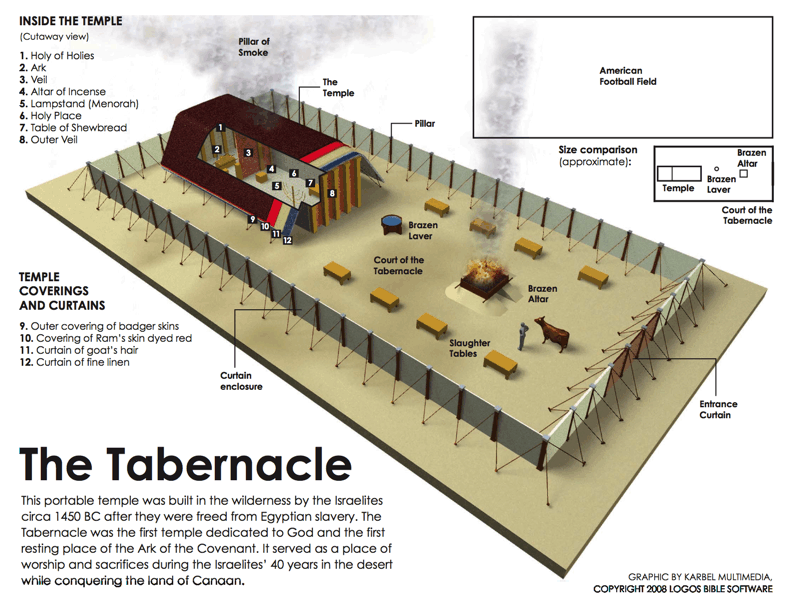
Heb 9:1-5 Again foreshadowings of the reality which is ChristHeb 8:7, but the substance is Christ Col 2:17Let’s take a stab at meaning and symbolism: Can it be that the Tabernacle now in Heaven, once on earth, is a type of Christ? Consider its elements:
It was on earth with the Jews, it is now in Heaven as is our Lord.
The golden altar of incense signifying how Christ ever lives to make intercession for us
It is covered around gold over wood, the living Christ in the flesh, wrapped in the majesty of gold.
The golden jar of manna is Jesus, the Bread of Life
The budding rod of Aaron is the symbol of Godly authority
The tables of the covenant are the perfection of the Law solely observed by Christ.
Heb 9:6-7 Once again, the writer drives home the point that the covering sacrifices and rituals are no longer necessary; the work was finished on the cross. “Te telesti” John 19:30. The human condition is such that we tend to fall away from relationship to ritual, in our personal relationships (can anyone say Facebook?), and in our worship, (do you sometimes go through the motions during worship or reading the Bible?). God understands this, and calls us out of ritual back to relationship through pursuing and heeding what He has to tell us through His written document.
Heb 9:8-10   This speaks as the Tabernacle was still standing, and previously that the Old Covenant was about to be done away with, signifying perhaps the imminent destruction of the Temple.People try to tear down the goodness of the Law and the Bible mockingly by pointing out obscure parts of it like two different kinds of cloth were not to be interwoven.The Law had three parts, the moral law (for instance, the 10 Commandments  eco 20:1-ft, Lev 19:18), civil law (for instance Lev 25:8-55 ), and ceremonial law (for instance Exo 25:10). This passage testifies that the ceremonial part of that law is about (and now is) done away with.
Heb 9:11-14 So, what ARE the “good things to come?Jesus entered, He offered, He obtained. What are the differences between He and the OT high priest?The annual sacrifices were a reminder to the people that they were sinners, who needed continual sacrifices to cover their sins. When Jesus comes, not only is the sin taken away, but our consciences are cleansed.
Heb 9:15-22 Titles of the Holy Spirit (see below)Testaments is best understood as a will. A will doesn’t take effect until somebody dies.
Heb 9:23-28 The shadows, the copies are the inferior representation of the actual, which is Jesus in Heaven, not high priest in tabernacle.


The Tabernacle of Moses

Memory Verse – One verse you have set to memory.“It is appointed for men to die once and after this comes judgment.” – Heb 9:27

Application – How will you live out what you have learned?
I will look to see where my life has become ritual and turn back to relationship.

.. humble themselves and pray and seek My Face, and turn from their wicked ways, then I will hear from heaven, forgive their sin, and heal their land. II Chron 7:14